
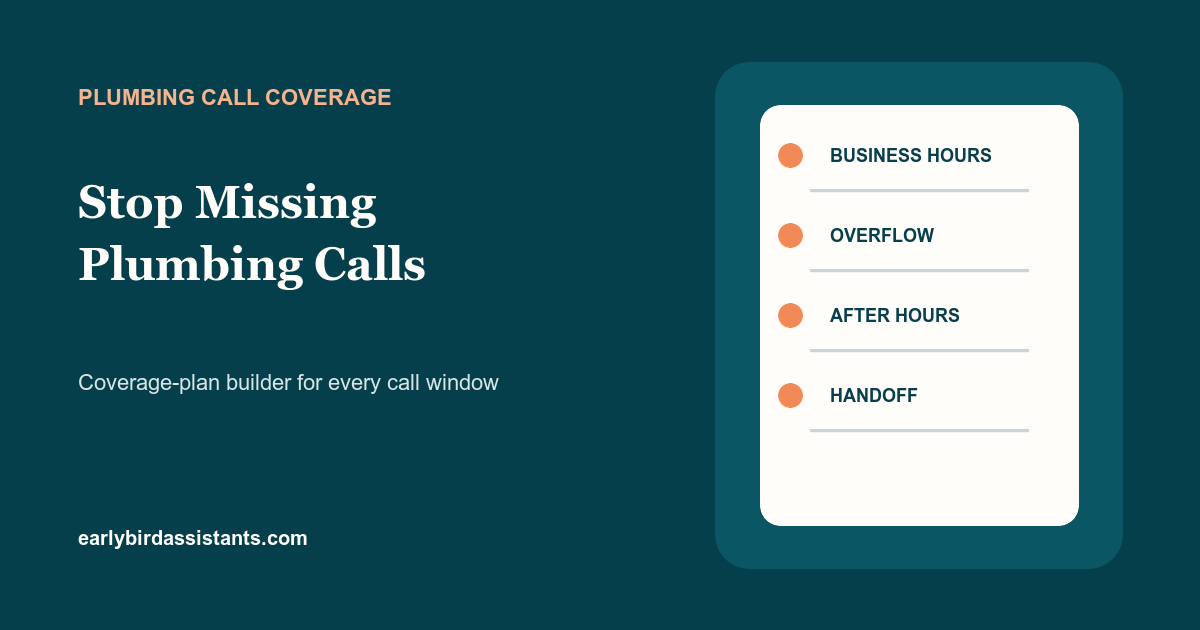
The short answer: stop treating missed plumbing calls as one staffing problem. Separate business-hours coverage, busy-line overflow, breaks, after-hours, and weekends. Give each window a first owner, a backup, an allowed action, and a handoff destination. Then test the route with your real phone system.
This may require another receptionist, but often it does not. A small shop may improve coverage with ring groups and a named rotation. A shared live service can cover narrow overflow or after-hours windows. A dedicated assistant can own calls plus the scheduling, records, confirmations, and follow-up that continue after the caller hangs up. The right answer depends on where the gaps occur and how much work follows each call.
Start with the five coverage windows
1. Normal business hours
Name the person who should answer first while the office is open. “The team” is not an owner. If the dispatcher is also updating the service board, coordinating plumbers and apprentices, and responding to active customer questions, write down which queue wins when two calls arrive together.
2. Busy-line and no-answer overflow
Decide what happens when the first owner is already speaking with a customer, away from the desk, or unavailable. Business phone systems can route calls to several endpoints. RingCentral's current documentation describes sequential or simultaneous forwarding and separate after-hours handling. Review RingCentral's call-handling documentation.
3. Breaks, meetings, and training
Lunch and weekly meetings are predictable, so they should not depend on someone remembering to grab the phone. Use a scheduled rotation, a ring group with accurate availability, or temporary overflow. Google Voice documents that an unavailable ring-group member can be skipped so the call moves to the next available person. Review Google Voice call availability.
4. After-hours calls
Choose the service you actually offer after hours. The call handler should follow the company's written intake and on-call routing rules, not diagnose a plumbing condition or invent an arrival promise. If your business offers only next-business-day follow-up, say so clearly. If there is an on-call route, name the person who accepts the handoff and the fallback when that person does not answer.
5. Weekends and holidays
Do not assume the weekday route still works. List special hours, on-call changes, planned closures, and the owner of the next-business-day queue. Test holidays separately because phone schedules, staff availability, and field capacity may all change.
Choose the lightest coverage model that closes the gap
A ring group or internal rotation fits when several people can answer from the same approved rules and someone maintains availability. It keeps the conversation inside the team, but it does not solve unclear ownership or simultaneous-call limits by itself.
A shared live answering service can fit a narrow backup window. Ruby's current service page says its receptionists can cover overflow and after-hours calls, transfer callers, take messages, and schedule appointments. Those are Ruby's described capabilities, not an independent quality finding. Review Ruby's current answering options. Before buying, test your exact greeting, intake fields, transfer path, scheduling rules, and unavailable-team fallback.
A dedicated assistant fits when the real gap continues after intake. The same person can carry approved work across the customer record, schedule, confirmations, estimate follow-up, memberships, and open-item reporting. One person cannot answer unlimited concurrent calls, so a growing shop may still pair a dedicated owner with overflow coverage.
Voicemail and callback may be reasonable for low-priority or closed-hour calls when the promised callback window is honest and someone owns the queue. It is a weak default when callers need live booking or the voicemail list is checked only when the field day slows down.
Build your plumbing call coverage plan
Use the planner below to assign each window. A “live lane” means a named person or service is expected to answer. Voicemail is counted as a documented backup, not live coverage. The summary is an operating checklist, not a prediction of bookings or revenue.
Original coverage-plan builder
Assign five call windows
Choose the first owner, then write the backup or handoff destination.
Assign each window to reveal the live-coverage and backup gaps.
How to use this: verify each route with a test call when the first owner is available, already on a call, and unavailable. Confirm that the record and promised next action reach the named owner. Keep technical judgment with the qualified person your company designates.
Write four rules beside every call route
- Required information. Keep the intake to what the next person needs, such as caller name, callback number, service address, request in the caller's words, customer status, and preferred timing.
- Allowed action. State whether the call handler may book inside approved windows, transfer, take a message, or create a callback request.
- Stop rule. When an answer depends on technical judgment, pricing authority, field capacity, or an exception, stop and route it to the responsible person.
- System of record. Name where the call details and next action live so dispatch and follow-up do not depend on memory.
Measure the route with your own records. Review calls by window, whether someone answered live, whether the required details were captured, and whether the next action was completed. Do not count an answered call as a success if the promised follow-up disappeared.
Where Early Bird fits
Early Bird is a managed service built around one dedicated, full-time executive assistant with ongoing Early Bird support. Onboarding maps the full operating scope, including systems, people, priorities, recurring work, and decision boundaries. The team then stabilizes one priority workflow at a time. That can begin with a connected call-handling lane, but the assistant is not hired for one disconnected task.
Early Bird's service agreement includes confidentiality obligations, and assistants sign nondisclosure agreements. These commitments do not replace appropriate permissions, client policies, or a written escalation path. Compare the broader models in the answering service vs. dedicated assistant guide, or review executive assistants for plumbing companies.